Productivity Workflow Template: The Simple System for Getting More Done Every Day
Staying productive isn’t about working longer hours—it’s about working smarter. Many people struggle with distractions, overwhelming to-do lists, and poor time management. The good news is that a structured productivity workflow can help you organize your day, improve focus, and complete important tasks without unnecessary stress.
A productivity workflow template gives you a repeatable system that removes guesswork from your daily routine. Instead of deciding what to do next, you follow a proven process that keeps you moving toward your goals.
Whether you’re a student, entrepreneur, freelancer, remote employee, or business owner, this guide will help you build a workflow that increases productivity while maintaining a healthy work-life balance.
What Is a Productivity Workflow?
A productivity workflow is a sequence of organized steps that guides you through your daily tasks in the most efficient order.
Rather than jumping randomly between activities, a workflow creates structure by helping you:
- Prioritize important work
- Plan your schedule
- Focus on one task at a time
- Reduce distractions
- Review your progress
- Improve continuously
The goal isn’t to become busier—it’s to become more intentional with your time.
Why You Need a Productivity Workflow
Without a clear workflow, it’s easy to:
- Waste time deciding what to work on
- Forget important tasks
- Feel overwhelmed
- Miss deadlines
- Constantly multitask
- Lose motivation
A simple workflow helps eliminate these problems by creating consistency in your daily routine.
Benefits include:
- Better time management
- Improved focus
- Less stress
- Higher-quality work
- More completed tasks
- Better work-life balance
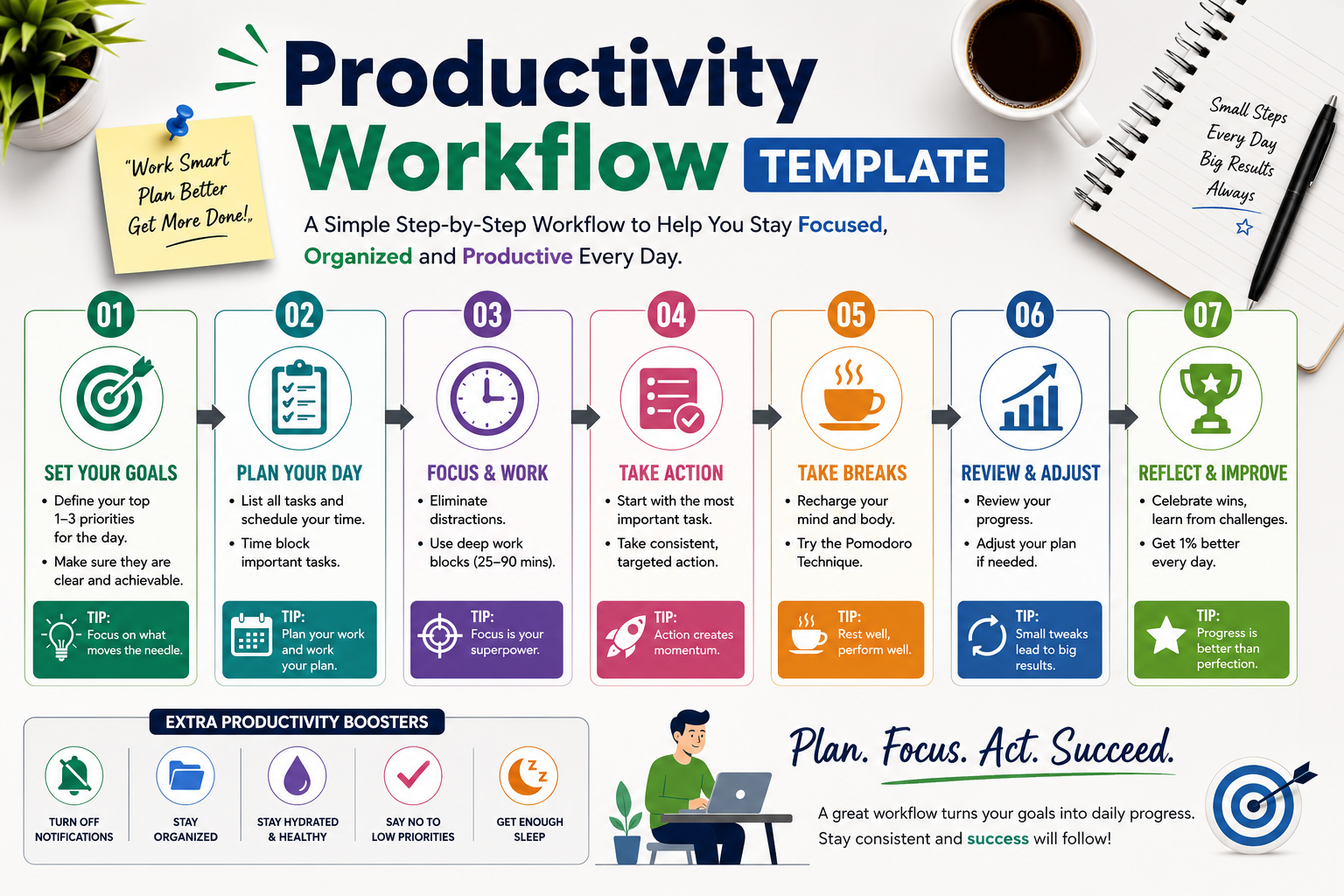
Step 1: Define Your Daily Goals
Start each day by identifying your most important priorities.
Instead of creating a massive task list, choose three to five high-impact tasks that will make the biggest difference.
Ask yourself:
- What absolutely needs to be finished today?
- Which task creates the greatest value?
- What can wait until tomorrow?
Having clear priorities makes decision-making much easier.
Step 2: Plan Your Schedule
Once you’ve identified your priorities, organize them into your calendar.
Many productivity experts recommend time blocking, where you assign specific time periods for different tasks.
For example:
Morning
- Email review
- Project planning
- Deep work session
Afternoon
- Meetings
- Client communication
- Administrative work
Evening
- Review progress
- Prepare tomorrow’s schedule
Planning reduces decision fatigue and keeps your day structured.
Step 3: Focus on One Task at a Time
Multitasking often decreases productivity instead of improving it.
Single-tasking allows your brain to concentrate fully on one objective before moving to the next.
Helpful strategies include:
- Turn off unnecessary notifications
- Close unrelated browser tabs
- Put your phone away
- Use noise-canceling headphones
- Work in focused time blocks
Even 30 to 60 minutes of uninterrupted focus can dramatically improve your output.
Step 4: Take Action Consistently
Planning is important, but execution creates results.
Begin with your highest-priority task while your energy is strongest.
Avoid waiting for the “perfect moment.”
Progress comes from consistent action—not perfection.
Remember:
Small improvements every day create significant long-term success.
Step 5: Take Strategic Breaks
Working nonstop often leads to burnout.
Short breaks help your brain recover, improve concentration, and increase creativity.
Try techniques such as:
- 25 minutes of focused work followed by a 5-minute break
- Walking for a few minutes
- Stretching
- Drinking water
- Taking deep breaths
Rest is part of productivity—not the opposite of it.
Step 6: Review Your Progress
Before ending your workday, spend a few minutes reviewing what you’ve accomplished.
Ask yourself:
- Which tasks were completed?
- What caused delays?
- What worked well?
- What can be improved tomorrow?
This daily review helps you continuously refine your workflow.
Step 7: Improve Your Workflow Every Week
Your productivity system should evolve over time.
Every week, evaluate your routine and look for opportunities to improve.
Consider:
- Eliminating unnecessary tasks
- Automating repetitive work
- Using better productivity tools
- Creating templates for recurring tasks
- Delegating when possible
Small adjustments often produce significant long-term improvements.
Helpful Productivity Tips
To maximize your workflow:
- Start with your most important task.
- Limit distractions.
- Keep your workspace organized.
- Batch similar tasks together.
- Use digital calendars and reminders.
- Stay hydrated throughout the day.
- Get enough sleep every night.
- Celebrate small wins to stay motivated.
Consistency is more valuable than occasional bursts of motivation.
Common Productivity Mistakes to Avoid
Even the best workflow can fail if you develop poor habits.
Avoid these common mistakes:
- Trying to multitask constantly
- Overloading your schedule
- Ignoring breaks
- Setting unrealistic goals
- Working without priorities
- Constantly checking social media
- Skipping daily planning
Recognizing these habits can significantly improve your productivity.
Final Thoughts
A productivity workflow template doesn’t have to be complicated. The most effective systems are often the simplest.
By defining clear goals, planning your schedule, focusing on one task at a time, reviewing your progress, and making small improvements each week, you’ll build habits that lead to long-term success.
Remember that productivity isn’t about being busy every minute of the day. It’s about consistently spending your time on what truly matters.
Start implementing this workflow today, stay consistent, and watch your efficiency grow one day at a time.
Frequently Asked Questions
What is a productivity workflow template?
A productivity workflow template is a structured process that helps organize tasks, prioritize work, manage time, and improve efficiency throughout the day.
Who can use a productivity workflow?
Students, professionals, entrepreneurs, freelancers, remote workers, content creators, and anyone looking to improve time management can benefit from using a productivity workflow.
How often should I review my workflow?
A quick review at the end of each day and a more detailed review once a week will help you continuously improve your productivity system.
Does a productivity workflow reduce stress?
Yes. Having a clear plan reduces decision fatigue, improves organization, and makes workloads feel more manageable.
Conclusion
Building a productive life starts with creating a repeatable daily system. A simple workflow can help you stay organized, complete meaningful work, and make steady progress toward your goals. Focus on consistency, keep refining your process, and remember that lasting success comes from small improvements practiced every day.